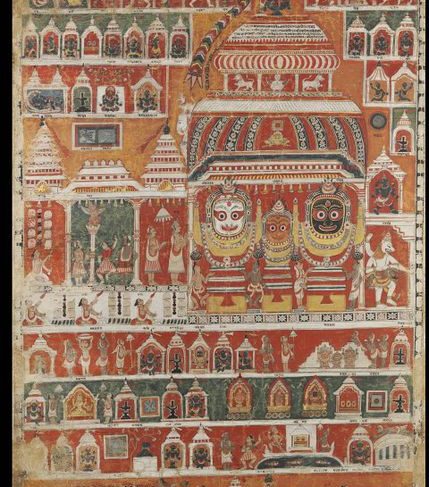
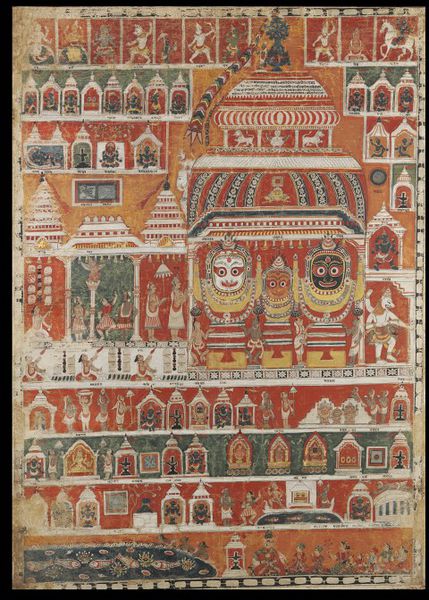
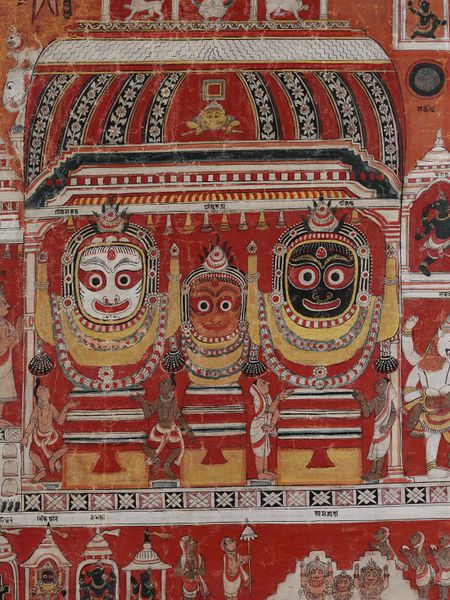
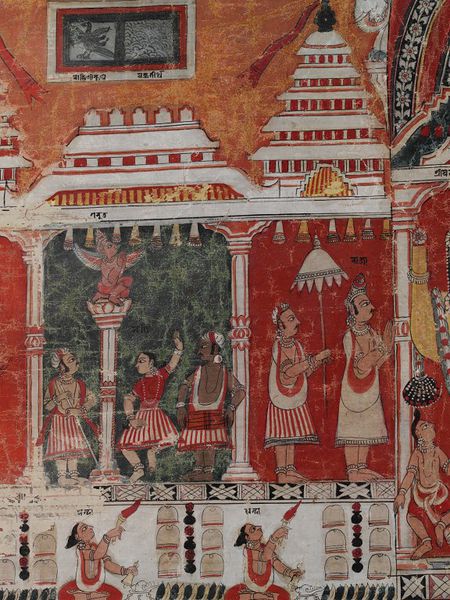
This painting on cloth (pata), done in the Orissan style, depicts the famous Jagannatha Temple in Puri, Orissa. Jagannatha, “Lord of the Universe”, is a form of Krishna around whom a highly popular cult emerged in Puri, attracting devotees from distant parts of India and establishing the city as a major pilgrim centre. The cult spread to Bengal and Assam and, judging from the evidence of this painting, to Nepal. Workshops producing devotional paintings for pilgrims prospered around the temple in Puri. This painting depicts the Jagannatha temple in all its complexity, with the sanctuary housing the triad of Jagannatha, Balabadra (Balarama) and Subhadra beneath the Orissan-style tower, the pillared hall to the left in which the Raja of Puri performs darshana, attended in priests and dancing devadasi. The numerous secondary shrines and other features of the temple grounds, such as the holy bathing place for the deities, are depicted in detail.
A remarkable feature of this painting is that although it was most probably executed at Puri, it was sent to Nepal to mark a festival ritual performed by the ruler of Bhaktapur. The painting bears a Newari inscription, visible on the tower (sikhara) of the temple, identifying the donors and the ceremony this painting was commissioned to celebrate, the performing of the Avanta ceremony in honour of Visnu on the 14th day of Bradra (August-September) in the year Samvat 790 (= 1670). The donor’s title, Sri Jagaccandramalla, refers to king Jagatprakasamalla, the ruler of Bhaktapur from 1643 to 1672, and to his chief minister Candrasekhara Simha, who ruled jointly under this title. A portraits of the donors is to be found in the double-headed seated figure seen lower right, accompanied by members of the Bhaktapur royal family.
Physical description
This painting, done in the Orissan style, depicts the famous Jagannatha Temple in Puri, Orissa. Painted with water-based pigment on cotton cloth.
Historical context note
This painting, done in the Orissan style, depicts the famous Jagannatha Temple in Puri, Orissa. Jagannatha, “Lord of the Universe”, is a form of Krisna around whom a highly popular cult emerged in Puri, attracting devotees from distant parts of India and establishing the city as a major pilgrim centre. The cult spread to Bengal and Assam. In Nepal temples dedicated to Jagannatha were erected. This painting bears a Newari inscription, visible on the tower (sikhara) of the temple, identifying the donors and the ceremony this painting was commissioned to celebrate. The donor’s title, Sri Jagaccandramalla, refers to king Jagatprakasamalla, the ruler of Bhaktapur from 1643 to 1672, and to his chief minister Candrasekhara Simha, who appear to have ruled jointly under this title. The painting celebrates the performing of the Avanta ceremony in honour of Visnu on the 14th day of Bradra (August – September) in the year Samvat 790 (1670 A.D).
Descriptive line
Painting, Jagannatha temple at Puri, painted in Bhaktapur, Nepal, gouache on cotton, 1670
Bibliographic References (Citation, Note/Abstract, NAL no)
Guy, John: ‘Indian Temple Sculpture’, London V & A Publication, 2007, 87. pl.95.
ISBN 971851775095
Guy, John (ed.). ‘L’Escultura en els Temples Indis: L’Art de la Devocio’, Barcelona : Fundacio ‘La Caixa’, 2007. p.224. cat. 177.
ISBN 9788476649466
Details
- Title : View of the Jagannatha Temple, Puri
- Year : 1670 (painted)
- Artist : Unknown
- Classification : Paintings & Manuscripts
- Medium : Gouache on cotton
- Dimension : Height: 115 cm, Width: 82 cm
- Accession No : IS.64-1985
- Country/ Geo-location : Bhaktapur, Nepal
- Culture : Hinduism
- Collection : Victoria & Albert Museum (V&A)
- Status : In Storage