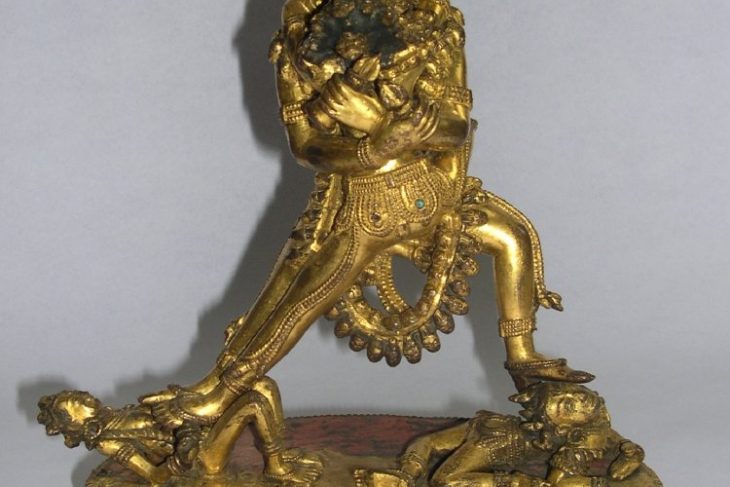
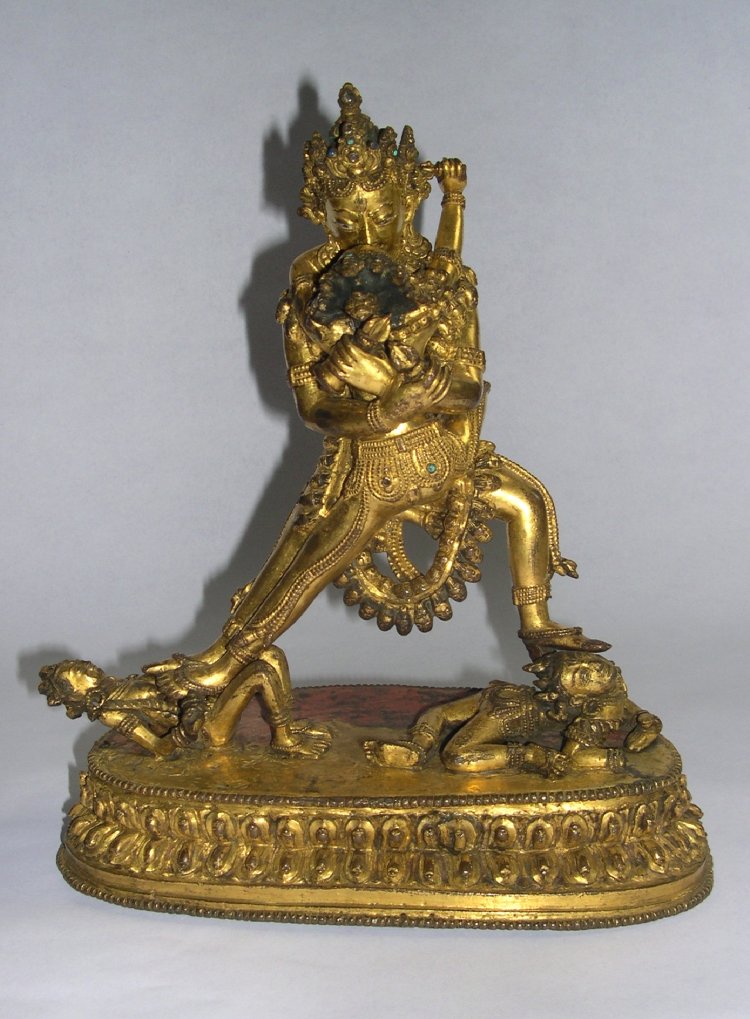
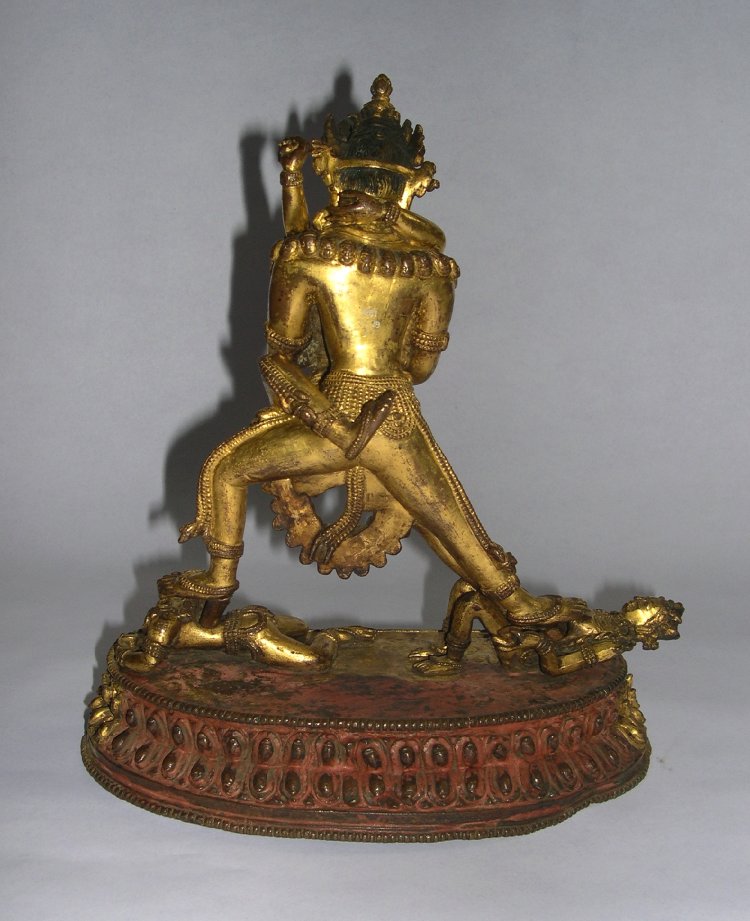
Two-armed Samvara (or Cakrasamvara) (yi-dam) and Vajravarahi (in yab-yum on a lotus base) cast in a copper gilt set with coloured stones; under their feet the subjugated Hindu deities Kalaratri and Bhairava.
Details
- Title : Two-armed Samvara (or Cakrasamvara) (yi-dam) and Vajravarahi
- Year : 16thC
- Classification : Figure/ Sculpture
- Medium : Cast in a copper gilt set with coloured stones
- Dimension : Height: 27 centimetres
- Accession No : 1921,0219.1 Object reference number: RRI6849
- Country/ Geo-location : Nepal
- Culture : Buddhism
- Collection : The British Museum
- Credit Line : Donated by: Louis King
- Acquisition Method : Donation: Acquisition date 1921
- Status : Not on display
- Curator's comments : For a two-armed Cakrasamvara in a 12th-13th century thangka, see Piotrovsky, Mikail Borisovich ed., Lost Empire of the Silk Road: Buddhist Art from Khara Khoto X-XIIIth Century (Milan: Electa & Thyssen-Bornemisza Foundation, 1993): p. 160, plate 27.Zwalf 1985A form of Samvara with one head and two arms is shown here in a vigorous posture, striding to the right and embracing his female partner. Both tread on Hindu gods, Bhairava, a form of Śiva, apparently holding a skull-cup, and his consort, Kālarātrī, with ritual knife and skull-cup; her emaciation, as goddess of death, is apparent from her pendulous breasts and angular arms and legs. Samvara holds his ‘vajra’ and ‘ghaṇṭā’ behind his consort's back, while she, one leg thrown over his left thigh above his lower garland of severed heads, holds a skull-cup and a broken ritual knife surmounted with the ‘vajra’ final.
- Bibliography : Zwalf 1985 163 Zwalf & Oddy 1981 no. 59
- Exhibition history : Exhibited:Buddhism: Art and Faith (BM 1985)