
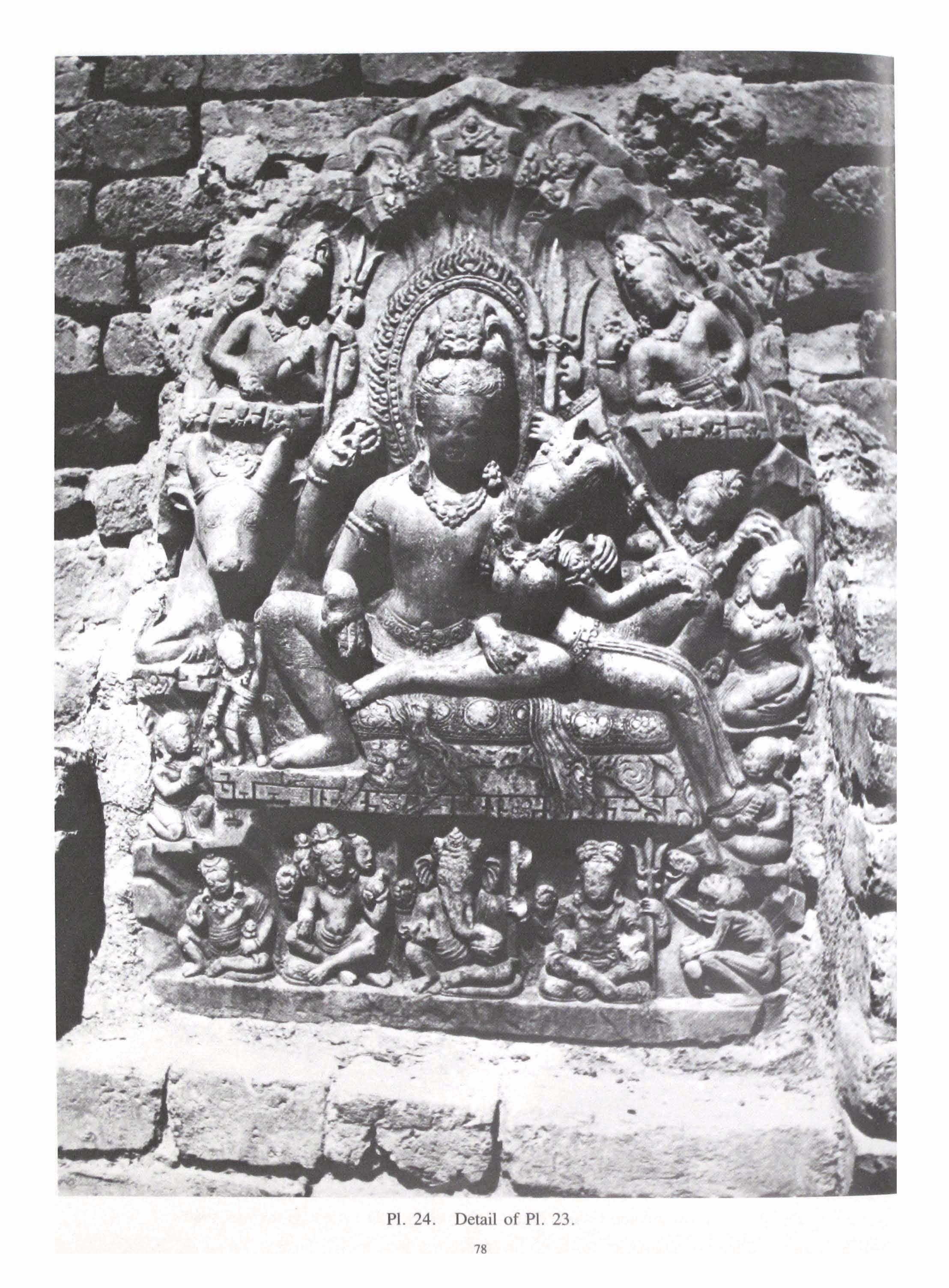

A remarkable relief of Uma-Mahesvara was located in Gahiti, about a hundred yards south-east of the Kumbhesvara Temple in Patan (PI. 23). The entire composition was dominated by Shiva and Parvati, who were shown joyfully sitting on Mt. Kailasha with a tiger skin spread over their cushion. Shiva’s ornaments consisted of a crown on his matted hair, earrings, a necklace, armlets, bracelets and an ornate girdle. He was seated in the lalitasana pose with his left leg folded on the seat while his right leg was pendent. A beautiful flame halo was shown behind his head. The four-handed god held a rosary and a trident in his upper left and right hands, respectively His lower right hand held a citrus fruit in the open palm, while his left hand embraced his wife Parvati (Uma). The oval relief had an unusual feature around the rock motif where overgrown creepers and flowers were delineated above Shiva’s head. This feature was seen for the first time in an Uma-Mahesvara panel (PI. 24).
Wearing beautiful ornaments, Parvati was represented leaning playfully towards Shiva while her beautiful face expressed joy and ecstasy. Her right arm rested on Shiva’s thigh and her left hand on her own knee. On her left side, three female attendants as ladies-in-waiting were shown: one holding a parasol and a fly-whisk, the other a basket and a sword; while the third was shown massaging Parvati’s foot.
Above the divine couple, two guardian deities were represented on either side, each holding a rosary, a trident, a waterpot and a citrus fruit in his hands. On the right side of Shiva, Nandi, the bull, was sitting; and just below him was Kumara, who was shown with his left hand touching his father’s knee in adoration, while his right hand rested on his mount, the peacock.
Below the throne of the divine couple, five ganas of Shiva, were depicted in which Ganesha occupied the central position. He held a rosary, an axe, a radish and a basket of sweets in his four hands. On his right, three-headed Bhringi, with three arms and three legs, was shown sitting with crossed legs. In Nepal, Bhringi is portrayed in two forms: one with three heads, three arms and three legs, and the other a skeletal Bhringi, like the one shown in the extreme left of this panel. Skeletal Bhringi was depicted in a crouching posture and holding a waterpot in his left hand while his right hand was raised up in adoration to his master. A very interesting figure of gana was shown in the extreme right of the panel. He was wearing a bell-earring, and held a flower in his left hand, while his right hand was displayed in the gesture of munificence. He could be identified as Ghantakarna because of his association with the war god, Skanda. Another gana, seated on the left of Ganesha with a grinning human face in his belly, could be identified as Kumbhanda or Odaramukha.
Basically, in all the Uma-Mahcsvara reliefs, the artists of Nepal have followcd the same iconographic tradition, and ganas wcrc always portrayed dancing in a frolicsome mood. Unfortunately, this remarkable reflief was stolen in the mid 1960’s.
PUBLISHED
Pratapaditya Pal, The Arts of Nepal, PL. 1 . Scull>turc,
(LeidenIKoln, 1974), Fig. 134.
Stella Kramrish, Manifestations of .Shivs, Philadelphia
Museum of Art, (Philadelphia, 1981), PI. 5 1.
Krishna Deva, Images ofNepal, The Director General
Archaeological Survey of India, (New Delhi, 1984), 1’1.
L.
Lain S. Bangdel, 2500 Years of Nepalcse Art, VEB A.E.
Seemann Verlag (Leipzig GDR, 1987), PI. 62.
Details
- Title : Uma-Mahesvara
- Year : 10th century A.D.
- Medium : Grey-limestone
- Dimension : Ht. 29. 1/2 inches
- Accession No : Stolen, in the mid 1960'8.
- Country/ Geo-location : Gahiti, Patan
- Collection : Stolen Images of Nepal – Lain S.Bangdel