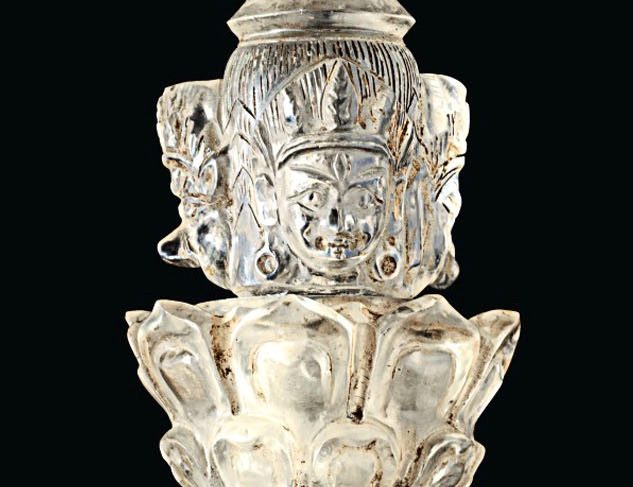
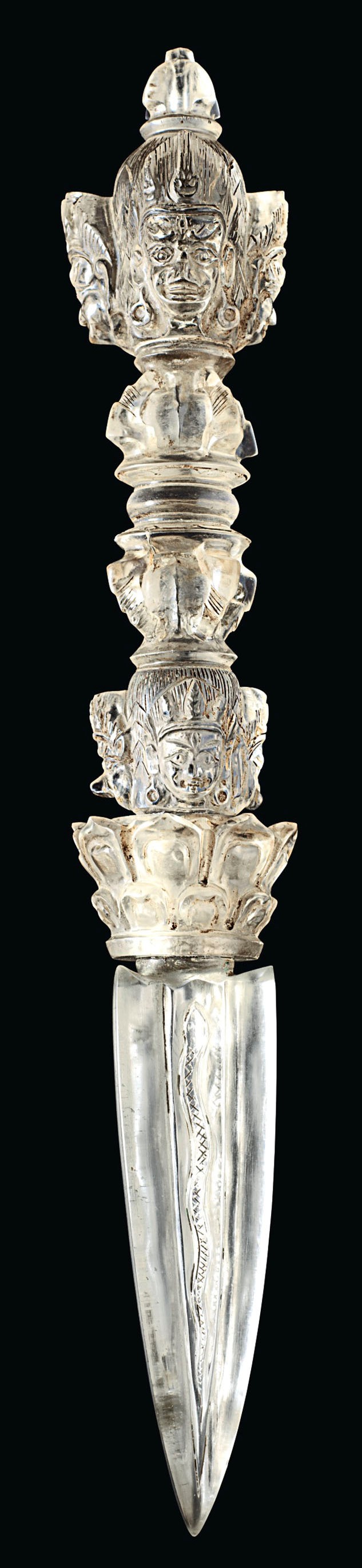
The finial topped with a half-vajra and the heads of three deities, above an eight-pronged vajra and three additional animal-form faces, and a two-layered round of lotus pads stacked above the tripartite blade, with snakes meandering down each side
10 ¼ in. (26 cm.) high
The kila is an important tool of Newari Buddhist priests and shaman. This Vajrayana Buddhist ritual implement, known by the same name in both Sanskrit and Newari, has parallels that suggest possible Vedic origins, such as the lightning bolt wielded by Indra in his battle against Vritra and the wooden spikes referred to in early Sanskrit ritual texts. The present example is crafted with the faces of various deities, distinguishing it as a ritual tool of the Vajrayana tradition still active in the Kathmandu Valley.
Compare the present kila with an example at the Musée Guimet, illustrated by G. Béguin, in Art ésotérique de l’Himâlaya: La donation Lionel Fournier, Paris, 1990, p. 159, cat. no. 91. The Guimet example, dated as eighteenth century, is stylistically identical to the present example, although the components are slightly different, with the blades emerging from a makara head, rather than the lotus pads, while also lacking the three animal-form heads of the current example.
Details
- Title : A ROCK CRYSTAL BHAIRAVA KILA
- Classification : Sculpture
- Dimension : 10 ¼ in. (26 cm.) high
- Country/ Geo-location : Nepal
- Period : 18TH CENTURY OR LATER
- Collection : Christies
- LOT : 1103
- Pre-Lot Text : THE FLORENCE AND HERBERT IRVING COLLECTION
- Price realised : USD 30,000
- Estimate : USD 25,000 - USD 35,000
- Provenance : Donald J. Wineman, 1 November 1989 *The Irving Collection, no. 552.