
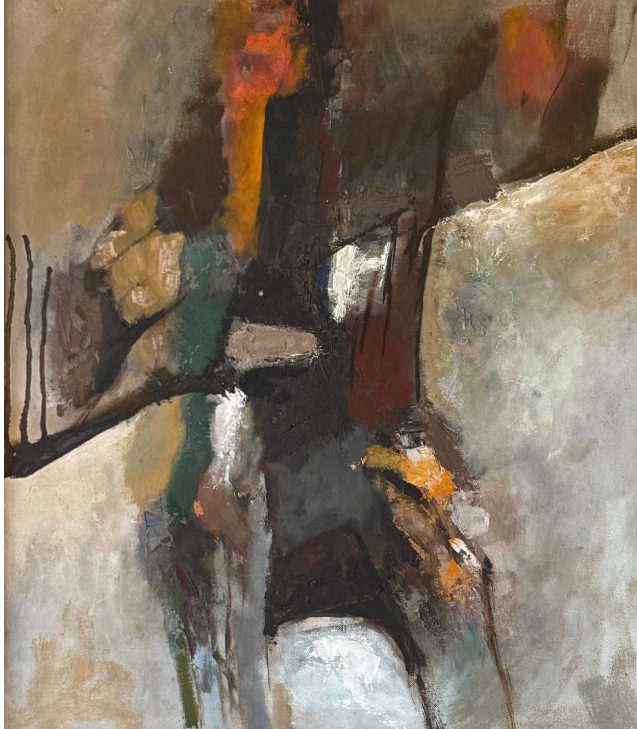
What draws you in first is the weather of it, the way ash-gray air seems to drift across the canvas while pockets of heat push through in rust, ember orange, and dense black. The surface feels worked, then reworked: scraped back, scumbled, and pressed forward again until the paint starts to read like memory, thick in some places and thin as breath in others. Nothing is announced plainly, yet you sense a figure or structure hovering near the center, a dark vertical spine that steadies the rest of the picture’s restlessness.
Lain Singh Bangdel’s palette is earthy without being dull. The blacks are alive; they carry light inside them. A streak of saffron rises like a flare and then settles into the surrounding smoke. There is no single “subject,” but you can feel the painting arriving at a balance between force and pause, gesture answered by stillness. That balance is what gives it poise. You see the hand: bold pulls of the brush, then a hesitation, then a softer pass that lets earlier layers whisper through.
1968 was a noisy year in the world at large, but Bangdel’s noise is inward. He is in dialogue with European abstraction, with its freedom and appetite for risk, yet the mood here is more meditative than declarative. You can sense the School of Paris and Art Informel in the work: the mineral light of Nicolas de Staël, the inky gravitas of Pierre Soulages, the slashed velocities of Hans Hartung. There are echoes of Jean Fautrier’s bruised tactility and Wols’s nervous line. From across the Atlantic, Abstract Expressionism hums at the edges, including Franz Kline’s structural clangor and Rothko’s breathing fields, tempered by the lyric intelligence of Braque and the poised, probing play of Paul Klee. The space he makes is not a void you fall into; it is a room you can breathe in. Gray becomes not emptiness but atmosphere. The painting asks for your attention and then rewards it with slow discoveries: a seam of white that reads like light on stone, a charcoal edge that turns to calligraphy when you notice how sure the wrist had to be.
Stand back and the painting holds together as a weather system, with fronts colliding, a clearing on the right, and pressure bearing down in the middle. Step closer and it becomes about touch. You can feel where the brush dragged, where the knife skimmed, and where the artist let the stain sink until canvas and color became one skin. That intimacy matters. It keeps the picture from grandstanding and lets it speak at human scale.
It is also a moment of travel and exchange for Bangdel. In 1968–69 he attended Denison University in Granville, Ohio, on a Fulbright Scholarship, a period that sharpened his conversation with international modernism while preserving his quiet, inward register. You feel that worldly contact here, not as citation but as pressure in the paint. The work is cosmopolitan in language and composed in temperament.
Bangdel often gets framed as a bridge between East and West, and between tradition and modernity, but bridges can be cold metaphors. Here the connection feels lived, not declared. The painting is worldly in its language and quiet in its temperament. It does not tell you what to think. It gives you time. And in that time, the eye adjusts: the blacks lift, the oranges cool, and what first seemed uncertain begins to feel inevitable, as if the image had always been there, waiting to be uncovered rather than made.
Some works deliver their meaning all at once. This one is generous in a different way. It meets you halfway. The longer you stay, the more the painting trades its turbulence for calm, and then, almost imperceptibly, back again. That ebb and flow is the point. It is not about solving the picture; it is about noticing how it changes the longer you are willing to look.
Lain Singh Bangdel’s palette is earthy without being dull. The blacks are alive; they carry light inside them. A streak of saffron rises like a flare and then settles into the surrounding smoke. There is no single “subject,” but you can feel the painting arriving at a balance between force and pause, gesture answered by stillness. That balance is what gives it poise. You see the hand: bold pulls of the brush, then a hesitation, then a softer pass that lets earlier layers whisper through.
1968 was a noisy year in the world at large, but Bangdel’s noise is inward. He is in dialogue with European abstraction, with its freedom and appetite for risk, yet the mood here is more meditative than declarative. You can sense the School of Paris and Art Informel in the work: the mineral light of Nicolas de Staël, the inky gravitas of Pierre Soulages, the slashed velocities of Hans Hartung. There are echoes of Jean Fautrier’s bruised tactility and Wols’s nervous line. From across the Atlantic, Abstract Expressionism hums at the edges, including Franz Kline’s structural clangor and Rothko’s breathing fields, tempered by the lyric intelligence of Braque and the poised, probing play of Paul Klee. The space he makes is not a void you fall into; it is a room you can breathe in. Gray becomes not emptiness but atmosphere. The painting asks for your attention and then rewards it with slow discoveries: a seam of white that reads like light on stone, a charcoal edge that turns to calligraphy when you notice how sure the wrist had to be.
Stand back and the painting holds together as a weather system, with fronts colliding, a clearing on the right, and pressure bearing down in the middle. Step closer and it becomes about touch. You can feel where the brush dragged, where the knife skimmed, and where the artist let the stain sink until canvas and color became one skin. That intimacy matters. It keeps the picture from grandstanding and lets it speak at human scale.
It is also a moment of travel and exchange for Bangdel. In 1968–69 he attended Denison University in Granville, Ohio, on a Fulbright Scholarship, a period that sharpened his conversation with international modernism while preserving his quiet, inward register. You feel that worldly contact here, not as citation but as pressure in the paint. The work is cosmopolitan in language and composed in temperament.
Bangdel often gets framed as a bridge between East and West, and between tradition and modernity, but bridges can be cold metaphors. Here the connection feels lived, not declared. The painting is worldly in its language and quiet in its temperament. It does not tell you what to think. It gives you time. And in that time, the eye adjusts: the blacks lift, the oranges cool, and what first seemed uncertain begins to feel inevitable, as if the image had always been there, waiting to be uncovered rather than made.
Some works deliver their meaning all at once. This one is generous in a different way. It meets you halfway. The longer you stay, the more the painting trades its turbulence for calm, and then, almost imperceptibly, back again. That ebb and flow is the point. It is not about solving the picture; it is about noticing how it changes the longer you are willing to look.
Details
- Title : Untitled
- Year : 1968
- Artist : Lain Singh Bangdel
- Classification : Painting
- Medium : Oil on board
- Dimension : Size 24 × 20 in | 61 × 50.8 cm, Framed Size 30 1/2 × 26 1/2 in | 77.5 × 67.3 cm
- Collection : Tansbao Gallery
- Credit Line : Tansbao Gallery
- Acquisition Method : Actioned
- Status : Frieze Seoul I 2- 5 Sept 2026 I For sale I Tansbao Gallery I Sold